How to Build an Online Training Program Clients Follow: 7 Steps
7 min read · Updated Oct 13, 2026
Short answer
To build an online training program, start with an assessment of the client’s goal, schedule, equipment and history, then pick a split that fits their available days. Choose exercises they can do safely alone, set a clear progression rule and planned deloads, deliver it in an app with demo videos, and adjust it from their logs and weekly check-ins.
Learning how to build an online training program is mostly learning to coach someone you can’t watch. In the gym you fix a bad squat on the spot. Online, the program has to do that work: exercises the client can perform alone, instructions they can follow, and numbers that tell you what happened.
This guide walks through seven steps, from the first assessment to the weekly adjustments, with example splits and a progression rule you can copy. It works for fully online clients and for hybrid clients who also train with you in person.
What should you assess before building an online program?
Assess the client’s goal, available days and session length, equipment, training history and anything that hurts. Those answers decide the split, the exercises and the starting loads, so collect them before you write a single workout.
- Goal. One main goal for the next 8 to 12 weeks, such as fat loss, strength or muscle gain. Two equal goals usually produce a vague program.
- Schedule. How many days a week they can realistically train, and for how long. Plan for the number they can keep in a busy week, not their best week.
- Equipment. Full gym, dumbbells at home, or a hotel gym twice a month. If they train at home, ask for a photo or a list.
- Training history. How long they have trained consistently and which lifts they already know. A beginner and a returning lifter need different exercise choices.
- Pain and injuries. Anything that hurts during or after training, and what a doctor or physio has said. Refer out when something needs medical care.
- Movement check. A short video of a squat, a hip hinge and a push-up, so you see their form before you load it.
The guide on onboarding new clients covers the full intake questionnaire. For programming, these are the answers that matter.
Which training split should online clients follow?
Pick the split from the number of days the client can actually train, not from what you like to train. A few reliable sessions beat an ambitious plan that falls apart in week three.
- 2 days a week: two full-body workouts, A and B, each with a leg exercise, a chest or shoulder exercise, a back exercise and core work.
- 3 days a week: three full-body workouts, or a chest workout, a back workout and a leg workout for clients who prefer one focus per session.
- 4 days a week: upper body and lower body, twice each.
- 5 to 6 days a week: chest, back and legs twice through, or chest, back, legs, shoulders and arms for experienced clients with time to recover.
If a client misses sessions often, full body is the safer choice. Each workout covers the whole body, so a missed day costs less.
How do you choose exercises for an online workout program?
Choose exercises the client can do safely without you, with the equipment they actually have, and give every one a demo video. Online, the question is less about the ideal movement and more about the one they will do well alone.
- Start stable. Machines, dumbbells and supported variations are easier to learn from a video than complex barbell lifts. Move to harder versions once their form videos look good.
- Cover the main patterns. A squat or leg press, a hip hinge, a horizontal and a vertical press, a horizontal and a vertical pull, and some core work across the week.
- Add a demo and one cue. A short video plus one or two cues, such as “ribs down” or “pause at the bottom”, beats a paragraph of instructions.
- Write a swap. Give one alternative for each main exercise, for a busy gym or a week of travel, so the client doesn’t improvise.
- Keep the list short. Four to six exercises per session is enough for most online clients. Long sessions get cut short, usually at the end, where the accessories are.
How should progression work in an online training program?
Give every exercise a written progression rule the client can apply without asking you. The simplest is double progression: a rep range, and a load increase once every set reaches the top of the range with good form.
- 1
Set a rep range
For example 3 sets of 8 to 12 reps, with one to three reps left in reserve on the last set.
- 2
Add reps first
Each week, try to add a rep or two at the same weight until all three sets reach 12.
- 3
Then add load
Move up to the next available weight, usually the smallest jump the gym has, and drop back to 8 reps.
- 4
Log every set
Weight and reps for every set, so both you and the client can see whether the rule is working.
For beginners, this alone can run for months. Intermediate clients may need weekly load targets or planned blocks, but the principle stays: a rule the client understands beats a plan only you can read.
When should an online program include a deload?
Plan a lighter deload week every four to eight weeks, or sooner when the logs show performance dropping across several sessions. The lighter week lets fatigue settle so training can keep moving forward.
- What changes: cut the number of sets by about half and keep the weights moderate. The exercises stay the same, so the routine doesn’t break.
- Signs it’s due early: reps falling at the same weight for two weeks, aching joints, poor sleep or low energy in check-ins.
- Explain it. Without a reason, a lighter week can feel like going backwards. With one, it’s part of the plan.
How do you deliver a program so clients actually follow it?
Deliver it where the client trains: on their phone, one workout at a time, with demo videos and a place to log each set. A PDF works for a one-off plan, but in ongoing coaching it hides the information you need to adjust the program.
- PDF or spreadsheet. Quick to make, but clients scroll to find today’s workout, logging in it is awkward, and every update means a new file. You only learn what happened when they tell you.
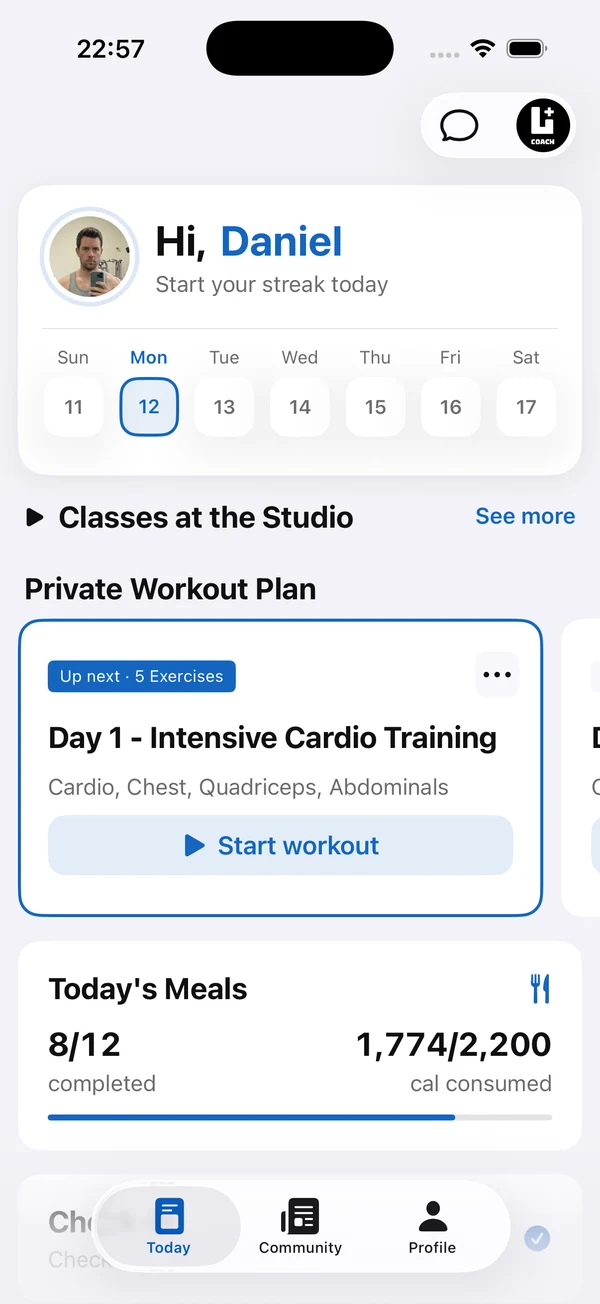
- Coaching app. The client opens today’s workout, each exercise has a video, and every set is logged. Changes reach the client as soon as you save them.
The guide on coaching apps versus spreadsheets compares the two in more detail. Whatever you use, send the first week of an online training program with a short note on what matters most, such as showing up to every session, rather than every rule at once.
How do you adjust a program from logs and check-ins?
Read the workout logs for performance and the weekly check-in for recovery, then change one thing at a time. Run a block for four to six weeks before rewriting it, so you can tell what worked.
- A lift stalls for two or three weeks: check sleep and nutrition in the check-in first, then change the rep range or swap the variation.
- An exercise keeps getting skipped: ask why, then replace it with one they will do. A great exercise they skip is worth less than a decent one they do.
- Sessions are missed: shorten the workouts or drop a training day. A plan that fits their real week beats a better plan they miss.
- Something hurts: swap to a variation that doesn’t hurt and ask for a form video. Refer out if it continues.
- Everything is going up: leave it alone. Often the best adjustment is none.
How Coach+ helps you build and deliver programs
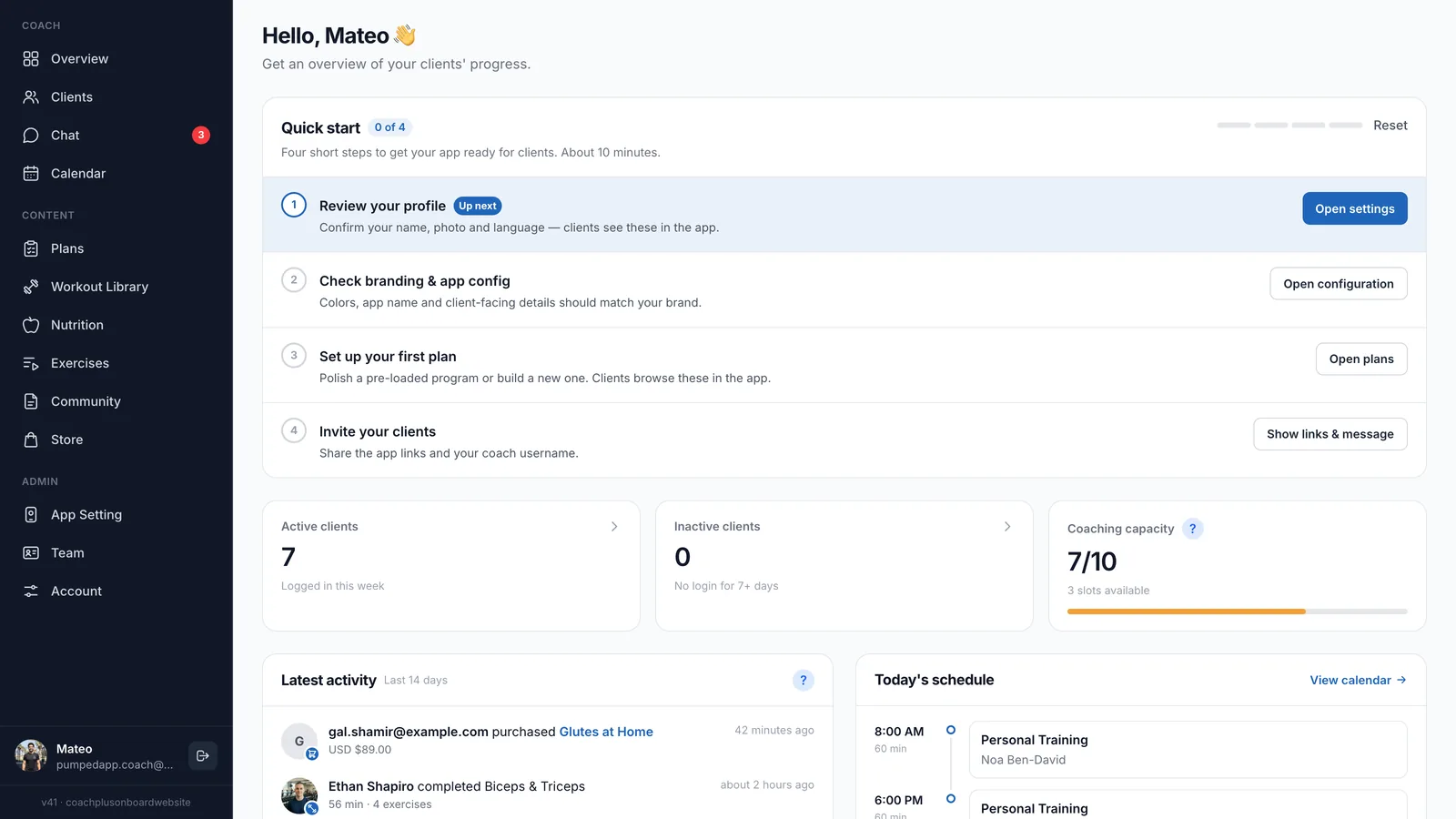
On the Coach+ coaching platform, you build programs in the coach dashboard and clients follow them in your own branded app, connected to it.
- A program builder with a library of 500+ exercises.
- Workouts in the client app with demo videos for the exercises.
- An AI assistant that drafts programs for you to review and edit before the client gets them.
- Existing Excel or PDF programs turned into plans, so you don’t start from zero.
- Set-by-set logging and progress graphs, so you see whether the progression rule is working.
- Weekly check-ins with progress photos, and messaging with push notifications, for the adjustments in step seven.
Quick checklist
- Goal, schedule, equipment, history and pain collected before writing
- A split based on the days the client can actually train
- Four to six exercises per session, each with a demo and a swap
- A written progression rule for every exercise
- A lighter week every four to eight weeks, or when the logs drop
- Delivered in an app the client can log in
- One change at a time, based on logs and check-ins
Frequently asked questions
How many days a week should an online training program be?
As many as the client can keep in a busy week, which for many people is two to four. Two full-body sessions done every week beat five planned sessions that turn into two.
How long should a workout program run before you change it?
Usually four to six weeks per block, or as long as the client keeps progressing. Changing exercises every week makes progress hard to see and gives the client no time to get good at the movements.
How do you check form when you can’t see the client train?
Ask for short videos of new or heavy lifts, filmed from the side, and reply with one cue at a time. Starting with stable exercises and demo videos reduces how much correcting you need to do.
Is a PDF workout plan enough for online coaching?
For a one-off program it can be. For ongoing coaching it is limited, because you don’t see what the client lifted and every change means a new file, so an app with set logging fits better.
Can AI write a training program for my clients?
AI can draft one, but a coach should check it against the client’s assessment. In Coach+, the AI assistant drafts programs and meal plans, and you review and edit them before the client gets them.