Calorie Calculator: How Many Calories Do You Need a Day?
Short answer
To find your daily calorie needs, calculate BMR with the Mifflin-St Jeor equation (10 × weight in kg + 6.25 × height in cm − 5 × age, +5 for men or −161 for women) and multiply it by an activity factor from 1.2 to 1.9. That is your maintenance calories (TDEE). Eat 500 less to lose fat or 300 more to gain muscle.
Maintenance calories
2,633
kcal/day
Fat loss
2,133
kcal/day · about 0.5 kg / 1 lb a week
Muscle gain
2,933
kcal/day · lean surplus
A calorie calculator gives you a starting number for how much to eat each day. It estimates the energy your body uses at rest, adds what you burn through work, movement and training, and turns that into three targets: maintenance, fat loss and muscle gain.
Treat the result as a first estimate, then adjust it based on what your weight actually does over a few weeks. Results are estimates for healthy adults and are not medical advice.
How to use the calorie calculator
- 1
Choose your sex and enter your age
The equation uses both, because resting energy use differs between men and women and goes down with age.
- 2
Enter your height and weight
Use your current numbers, not your goal weight. Weigh yourself in the morning before eating for the most consistent reading.
- 3
Pick your activity level
Count your whole week, including your job and daily steps, not only your workouts. If you are between two levels, choose the lower one.
- 4
Read your three targets
You get maintenance calories, a fat-loss target and a muscle-gain target. Pick the one that matches your goal and follow it for two to three weeks before changing anything.
How many calories should I eat a day?
Eat around your TDEE to keep your weight stable, about 500 calories below it to lose fat, and about 300 above it to build muscle. The calculator shows all three:
- Maintenance = TDEE. The calories that should keep your weight roughly the same at your current activity level.
- Fat loss = TDEE − 500. A daily deficit of 500 calories works out to roughly 0.5 kg (about 1 lb) of weight loss per week.
- Muscle gain = TDEE + 300. A small surplus that supports muscle growth when paired with strength training, while keeping fat gain modest.
How is TDEE calculated?
TDEE (total daily energy expenditure) is your BMR multiplied by an activity factor. BMR, the calories your body burns at complete rest, comes from the Mifflin-St Jeor equation:
- Men: BMR = 10 × weight (kg) + 6.25 × height (cm) − 5 × age + 5
- Women: BMR = 10 × weight (kg) + 6.25 × height (cm) − 5 × age − 161
Then BMR is multiplied by the factor for your activity level:
- Sedentary (1.2): desk job, little or no exercise.
- Lightly active (1.375): light exercise 1 to 3 days a week.
- Moderately active (1.55): exercise 3 to 5 days a week.
- Very active (1.725): hard exercise 6 to 7 days a week.
- Extra active (1.9): hard daily training, or a physical job plus training.
Example: a 30-year-old man, 180 cm and 80 kg, has a BMR of 10 × 80 + 6.25 × 180 − 5 × 30 + 5 = 1,780 calories. Moderately active, his TDEE is 1,780 × 1.55 ≈ 2,760 calories. His fat-loss target is about 2,260 and his muscle-gain target about 3,060.
How accurate is a calorie calculator?
A calorie calculator is a good starting point, not an exact measurement. Mifflin-St Jeor is one of the most widely used equations for adults, but it does not know your body composition, and people often overestimate how active they are.
- Follow the target for two to three weeks. Day-to-day weight jumps with water, salt and food in the gut, so look at the weekly average.
- Adjust in small steps. If the trend is not moving the way you want, change your daily calories by 100 to 200 and check again.
- Recalculate after real change. Run the numbers again when your weight changes noticeably or your activity level changes.
How coaches use calorie targets with clients
Personal trainers and online coaches use TDEE as the first calorie target for a new client, then let the weekly weight trend decide the next move. The target only works if the client knows it, can track against it, and checks in often enough for the coach to adjust it.
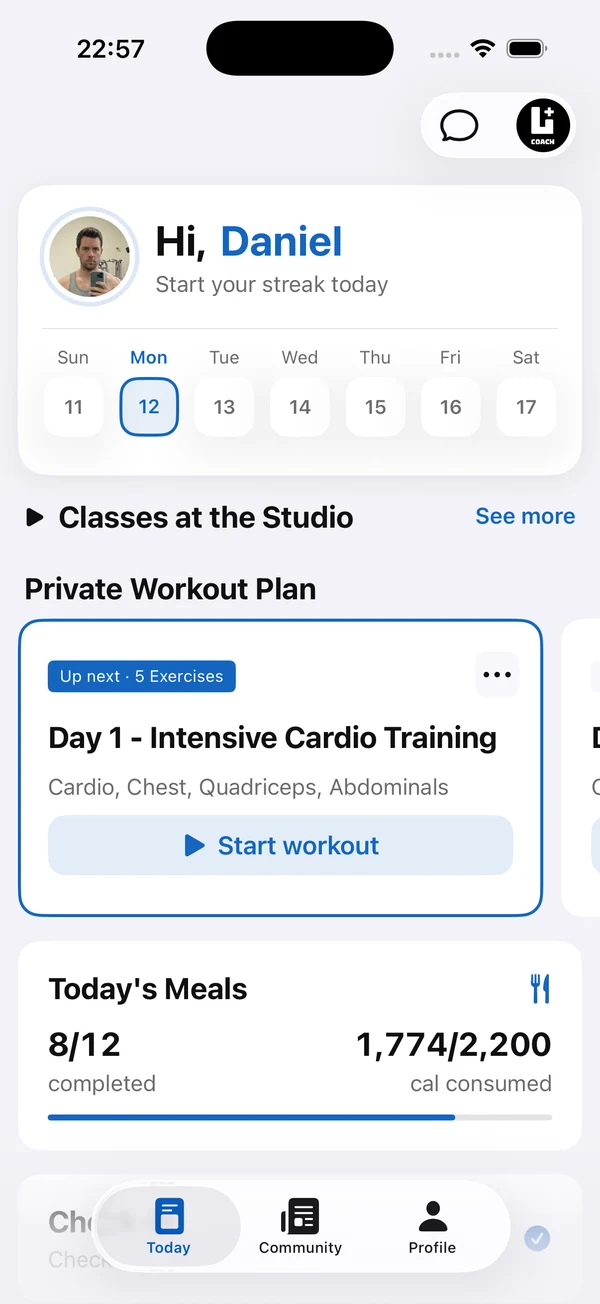
On the Coach+ coaching platform, you turn the number into a meal plan with macro targets, and clients log their food by barcode, photo or search in your own branded app. The AI assistant can draft a meal plan for you to review and edit, and weekly check-ins with weight and progress photos show when it is time to move the target.
Frequently asked questions
What is the difference between BMR and TDEE?
BMR is the energy your body uses at complete rest. TDEE is BMR multiplied by an activity factor, so it also includes work, daily movement and training. TDEE is the number to eat around to maintain your weight.
How many calories should I eat to lose weight?
A common starting point is your TDEE minus 500 calories a day, which works out to roughly 0.5 kg (about 1 lb) per week. Check your weight trend after two to three weeks and adjust from there.
Should I eat back the calories I burn exercising?
No, not if you used the calorie calculator with an activity level. The activity factor already includes your training, so adding exercise calories on top counts them twice.
How often should I recalculate my calories?
Recalculate when your weight has changed noticeably or your activity level changes, for example a new job or a new training schedule. Between those points, adjust by 100 to 200 calories based on your weekly weight trend.
Why am I not losing weight in a calorie deficit?
Usually because intake is higher than it looks or activity is lower than estimated, or because water retention is hiding fat loss for a while. Track food carefully for two to three weeks, then lower the target by 100 to 200 calories if the trend still has not moved.