How to Get Your First Personal Training Clients: A 90-Day Plan
8 min read · Updated Oct 13, 2026
Short answer
To get your first personal training clients, start with people who already know you: past clients, friends, colleagues and your gym. Offer a few beta spots at a reduced price for a fixed period in exchange for feedback and a testimonial. Then ask every satisfied client for one referral and add local and online channels.
How to get your first personal training clients is mostly a question of who you talk to first. Strangers need proof before they pay, and in the first months you have little of it. People who already know you need much less, which is why almost every coach’s first clients come from their own circle.
This guide covers the full sequence: warm outreach, a beta offer, testimonials, referrals, local and online channels, and a 90-day plan toward your first 30 clients. It works for in-person, hybrid and online coaching. If your audience is mainly on Instagram, the guide on turning Instagram followers into clients goes deeper on that channel.
Where do your first personal training clients come from?
Your first clients usually come from your warm network: people who know you, have trained with you or have seen you train. They already trust you, so one honest conversation can replace weeks of posting.
- Current and past clients. Anyone you trained at a gym, a studio or as a friend. Offer an online or hybrid option to those who moved, travel or stopped coming.
- Friends, family and colleagues. Not to sell to them, but to tell them clearly who you are looking for. Most first clients are a friend of a friend.
- Your gym or sports community. Running clubs, team mates, the people who see you train every week and already ask you questions.
- Professionals who meet your future clients. Physiotherapists, dietitians and other trainers with a different focus. A referral from someone they trust carries a lot of weight.
A practical start: write a list of everyone you could message this week. Most coaches find the list is longer than they expected.
How do you ask people you know without sounding salesy?
Ask for introductions, not purchases. A message that asks “do you know someone who fits?” is easy to answer and lets the reader raise a hand if it is them.
- Name one type of person. “People who want to start strength training after 40” gets more replies than “anyone who wants to get fit”.
- Say what is on offer and for how long. A number of spots, a length in weeks and what is included.
- Send it one to one. A personal message gets read. A group broadcast gets skimmed.
An example message to adapt: “Hi Dana, I’m opening a first round of online coaching for people who want to start strength training after 40. I have five spots for eight weeks at a launch price, in exchange for honest feedback. Does anyone come to mind who would fit?”
Should you offer a beta program to your first clients?
Yes, a short paid beta is usually a better start than free sessions. A reduced price still filters for people who will show up, and the fixed end date gives you a natural moment to move to full price.
- Limited spots. Five to ten clients is enough to learn from and still give everyone real attention.
- Fixed length. Eight to twelve weeks is long enough for visible results.
- Clear exchange. A lower price in return for feedback during the program and a testimonial at the end, if they are happy.
- Same service as full price. Same program quality, same check-ins, same reply times. Only the price is different.
Work out the full price before you discount it, so you know what the beta is a discount from. The guide on pricing online coaching and the free income calculator help with that number.
How do you get testimonials from your first clients?
Plan for testimonials from the first week by recording a starting point, then ask at the moment of a visible result.
- 1
Record the starting point
Photos, weight or measurements and a few baseline numbers, such as a squat or a push-up count. Without a “before” there is no story to tell.
- 2
Ask at a high point
Right after a personal best, a good check-in or the end of the beta. Not on a week when things went badly.
- 3
Ask three specific questions
What was the situation before, what changed, and what would they tell a friend who is considering it. Specific answers read as real.
- 4
Get written permission
Confirm in writing what you may share and where, especially photos. Offer to blur the face or use a first name only.
How do you get referrals from personal training clients?
Ask directly, at the right moment, for one specific kind of person. Happy clients rarely refer on their own because nobody asked them.
- Timing. After a result the client is proud of, not in the first week.
- One person, one profile. “Do you know one person with the same goal as you?” is easier to act on than “tell your friends”.
- Make it easy. Give them a short message they can forward as is.
- Thank them. A personal thank-you, or a small benefit such as a free extra week, if it fits your pricing.
Local or online: where should new coaches look for clients?
Use both, but start where people can see you in person. Local contact builds trust fastest, and online channels let those first results reach further.
- Local. A free weekly group workout in a park, a short talk at a workplace, a community center class or a partnership with a nearby physio. One recurring activity beats many one-off events.
- Online. Posts that teach one part of your method to your type of client, with the same next step every time. Local community groups often work better for a new coach than broad hashtags.
- Hybrid. Clients you meet locally can continue online between sessions or after they move, which turns one channel into the other.
A 90-day plan to get your first 30 clients
Thirty clients in 90 days is a target, not a promise. Treat it as math you can track: with hypothetical numbers, ten real conversations a week where one in four becomes a client gives about 30 clients over 13 weeks. Fewer conversations or a lower conversion means a longer timeline.
- 1
Days 1 to 14: one client type, one offer
Decide who you help, what the coaching includes, the full price and the beta price. Set up how you will deliver programs and check-ins before anyone signs up.
- 2
Days 1 to 30: warm outreach and the beta
Message everyone on your list one to one and fill five to ten beta spots. Onboard each client properly in their first week.
- 3
Days 31 to 60: results, testimonials, referrals
Keep weekly check-ins, collect the first testimonials as results appear, and ask each happy client for one referral. Start one recurring local activity.
- 4
Days 61 to 90: full price and the next round
Move beta clients to full price with written notice, share testimonials with permission, and open the next round of spots at full price.
- 5
Every week: count conversations and clients
Track how many conversations you had and how many became clients. Those two numbers show what to change faster than any feeling.
Keeping clients counts as much as getting them. A client who leaves in month two has to be replaced, so the guides on onboarding new clients and client check-ins matter here too, and the free client capacity calculator shows how many clients you can coach well.
How Coach+ helps you serve your first clients
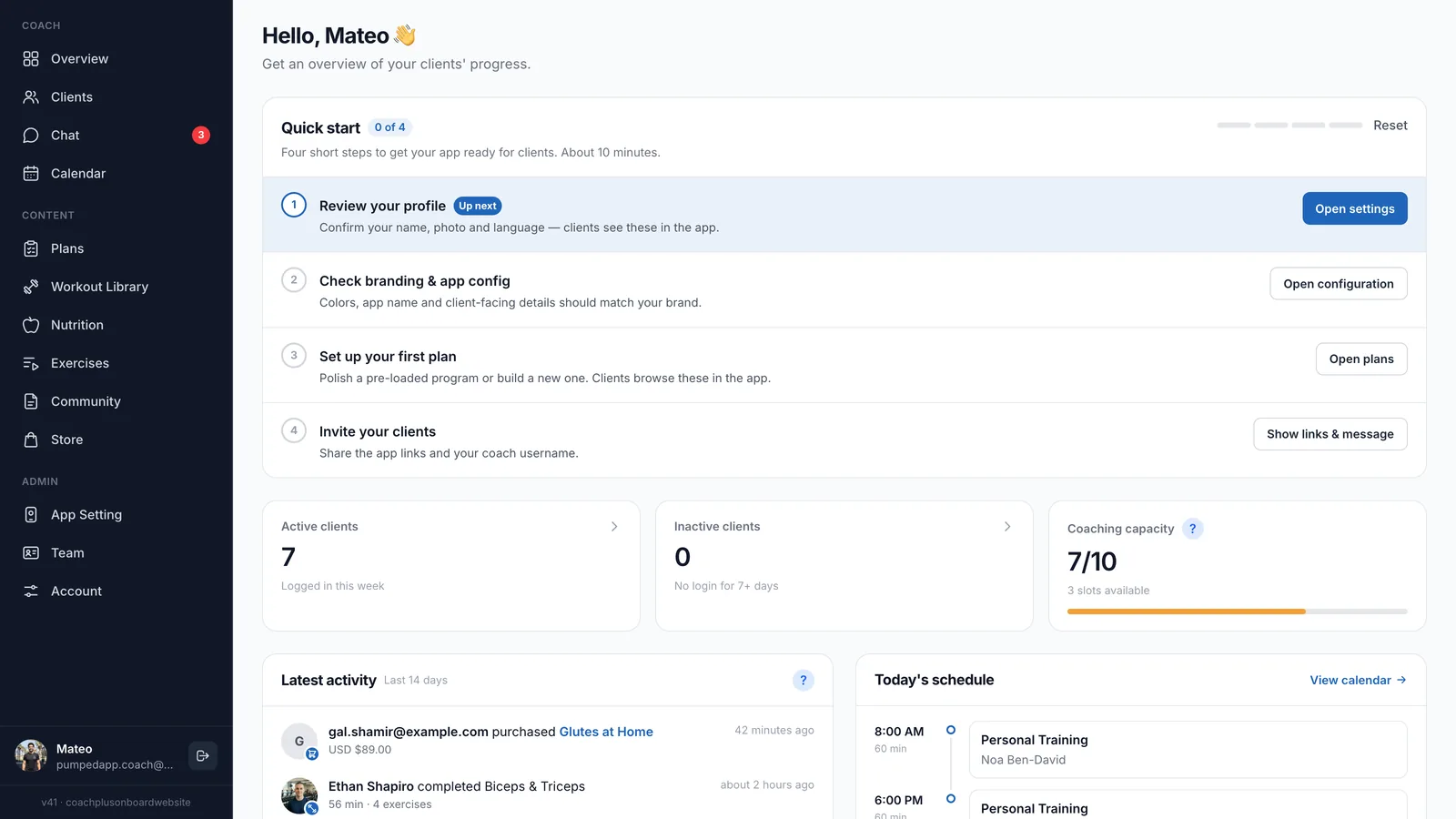
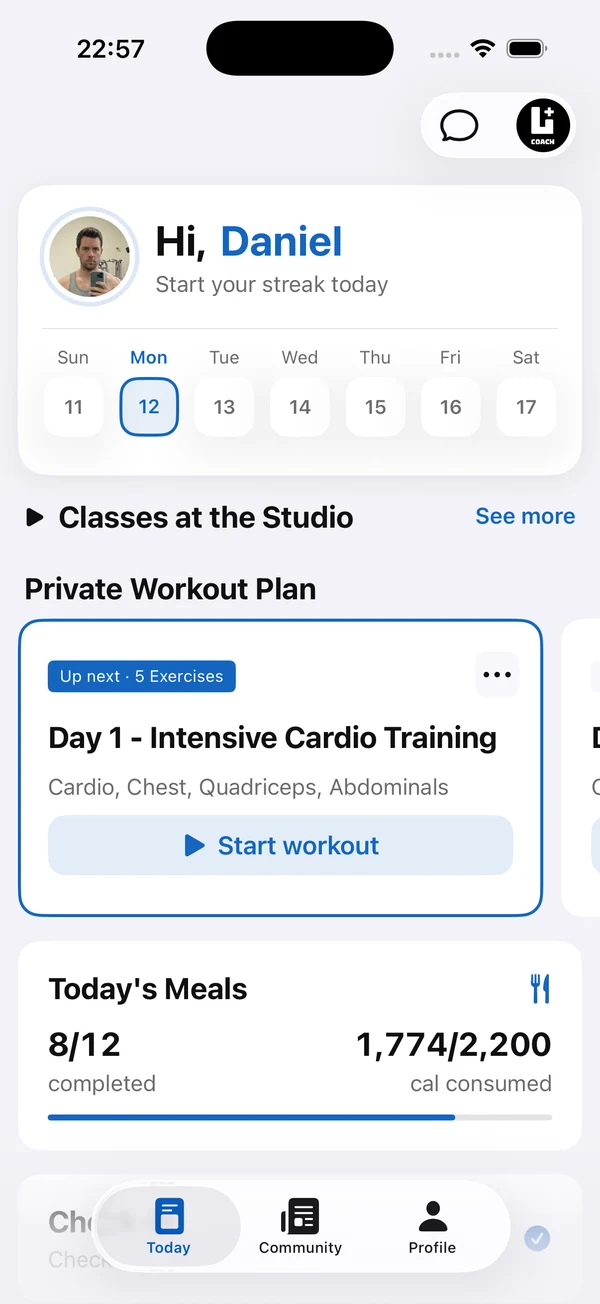
The Coach+ coaching platform gives you a coach dashboard and gives every client your own branded app, connected to it. First clients get a professional experience from day one, and you spend your time on coaching rather than on building spreadsheets.
- A program builder with 500+ exercises and demo videos, and an AI assistant that drafts programs and meal plans for you to review.
- Existing Excel or PDF programs can be turned into plans in the app.
- Weekly check-ins with progress photos and progress graphs, which give you the before and after for testimonials.
- A calendar clients book from themselves, for intro calls and assessments.
- A storefront with 0% commission, for a lower-priced program as an entry offer.
Quick checklist
- A written list of everyone you can message this week
- One client type and one offer, with a full price and a beta price
- Five to ten beta spots with a fixed end date
- Starting photos and numbers for every client
- Testimonials asked for at a high point, with written permission
- One referral request per happy client
- Conversations and new clients counted every week
Frequently asked questions
Should I train my first clients for free?
Usually not. A reduced price for a fixed period still filters for people who will show up and makes the move to full price easier. Free sessions work better as a single assessment than as ongoing coaching.
How long does it take to get your first coaching clients?
There is no reliable average, and it depends mostly on how many real conversations you have each week. A coach who messages their warm network directly can often sign a first client much sooner than one who only posts and waits.
Can you get personal training clients without social media?
Yes. Warm outreach, referrals, a recurring local activity and partnerships with physiotherapists or dietitians can fill a first round of clients without posting at all.
How many clients does a new personal trainer need?
Enough to cover your income target and costs at your price, within the hours you can coach well. Divide your monthly target plus costs by your monthly price, then check the result against your weekly hours.
What do I need to deliver coaching to my first online clients?
A way to send programs, collect logs and check-ins, and message clients. Coach+ gives each client your own branded app connected to your coach dashboard, with a 30-day free trial and no credit card required.