One Rep Max Calculator: Estimate Your 1RM From Any Set
Short answer
Your one rep max (1RM) is the heaviest weight you can lift for one clean rep. To estimate it from a set of 1 to 12 reps, average two formulas: Epley, weight × (1 + reps ÷ 30), and Brzycki, weight × 36 ÷ (37 − reps). Example: 100 kg for 5 reps gives about 115 kg.
1–12 reps for a reliable estimate
Estimated 1RM
212 lb
| % of 1RM | Load |
|---|---|
| 100% · ~1 rep | 210 lb |
| 95% · ~2 reps | 200 lb |
| 90% · ~4 reps | 190 lb |
| 85% · ~6 reps | 180 lb |
| 80% · ~8 reps | 170 lb |
| 75% · ~10 reps | 160 lb |
| 70% · ~12 reps | 150 lb |
| 65% · ~15 reps | 140 lb |
| 60% · ~20 reps | 125 lb |
A one rep max calculator tells you roughly how much you could lift for a single rep without actually testing it. You enter a weight and the number of clean reps you did with it, and the set turns into an estimated 1RM.
Use the estimate to choose working weights, track strength over time or run a percentage-based program, without the fatigue and risk of a true max attempt.
How to use the one rep max calculator
- 1
Pick a recent hard set
Use a set from the last week or two, taken close to failure with good form. A warm-up set will underestimate your max.
- 2
Enter the weight
Enter the total weight lifted, bar included, in kg or lb. The result comes back in the same unit.
- 3
Enter the reps
Enter 1 to 12 reps. Fewer reps give a more reliable estimate. If you enter 1 rep, the 1RM is simply the weight itself.
- 4
Read your 1RM and the chart
Below the estimate, the percentage chart shows the weight at each percentage of your 1RM and roughly how many reps that load allows.
How do you calculate your 1RM?
You calculate an estimated 1RM by plugging the weight and reps of one set into a 1RM formula. This calculator uses the average of two standard formulas, Epley and Brzycki:
- Epley: weight × (1 + reps ÷ 30)
- Brzycki: weight × 36 ÷ (37 − reps)
- Estimated 1RM: (Epley + Brzycki) ÷ 2
Example: 100 kg for 5 reps. Epley gives 116.7 kg, Brzycki gives 112.5 kg, and the average is about 114.6 kg. The same set in pounds, 225 lb for 5 reps, comes out at about 258 lb.
The two formulas agree exactly at 10 reps. Below 10, Epley reads a little higher; above 10, Brzycki does. Averaging them smooths out that difference. Reps are capped at 12 because high-rep sets depend more on muscular endurance than on maximal strength, so any formula drifts further from the real number.
What percentage of your 1RM should you lift?
Lift a higher percentage of your 1RM for fewer reps when the goal is strength, and a lower percentage for more reps when the goal is muscle or endurance. The chart pairs each percentage with the reps most lifters can do at that load:
- 100%: about 1 rep
- 95%: about 2 reps
- 90%: about 4 reps
- 85%: about 6 reps
- 80%: about 8 reps
- 75%: about 10 reps
- 70%: about 12 reps
- 65%: about 15 reps
- 60%: about 20 reps
Treat these as rough guides, not rules. Some lifters, and some exercises, allow more or fewer reps at the same percentage, so adjust after the first session if a set feels far too easy or too hard.
How do personal trainers use 1RM with clients?
Personal trainers and online coaches use an estimated 1RM to set starting loads for each lift and to see whether a client is getting stronger, usually without ever running a max test.
- Setting loads. A program written in percentages becomes real weights for each client as soon as you have an estimate for the main lifts.
- Tracking progress. If the estimated 1RM from a client’s logged sets keeps rising, the program is working, even in weeks when nothing feels like a personal best.
- Keeping beginners safe. Newer lifters get a usable number from a set of 5 to 8 reps instead of attempting a heavy single before their technique is ready.
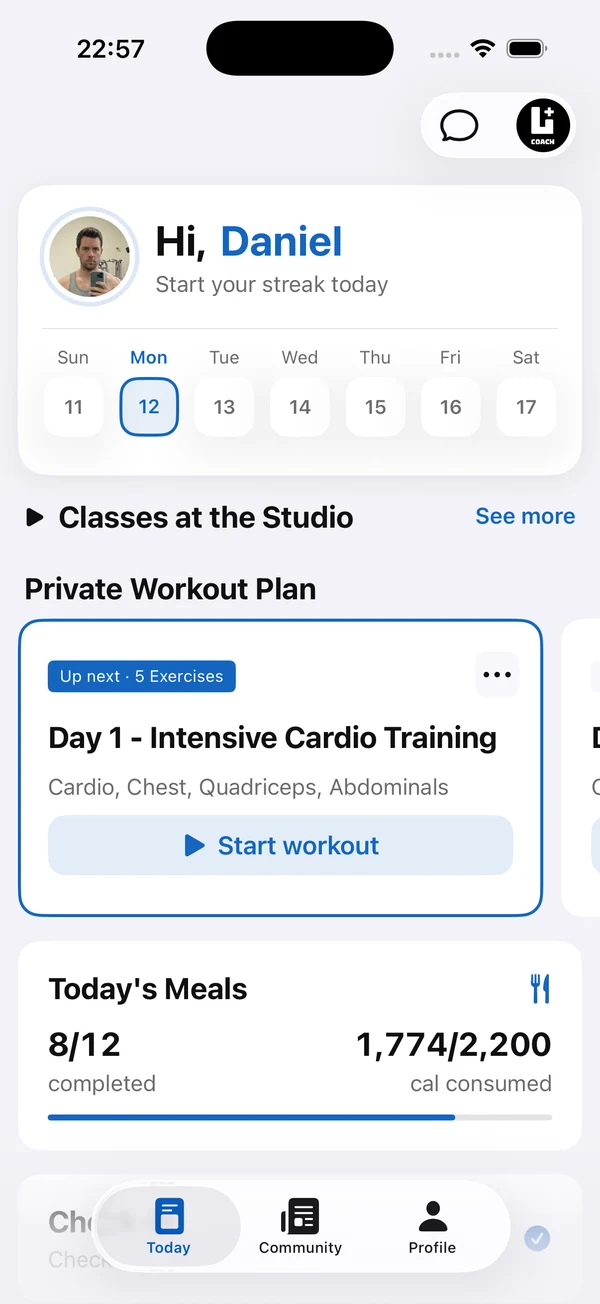
On the Coach+ coaching platform, clients log their workouts in your own branded app, so the weights and reps you need for a 1RM estimate are already there when you review their training. The AI assistant can draft a training program that you review and adjust before it reaches the client.
Frequently asked questions
How accurate is a one rep max calculator?
It gives an estimate, not a tested max. It is closest when the set is low-rep and taken close to failure, and it gets less reliable as reps go up.
Do I need to test my true 1RM?
Most people don’t; an estimate is enough to set training loads and track progress. If you do test a true max, warm up well and use a spotter or safety bars.
Does the 1RM formula work for every exercise?
It works best for compound barbell lifts such as the squat, bench press and deadlift. For small isolation exercises and some machines, the estimate is usually less reliable.
How often should I recalculate my 1RM?
Recalculate at the start of each new training block, or whenever your working sets feel clearly easier at the same weight. Use a recent hard set each time.
What is the Epley formula?
The Epley formula estimates 1RM as weight × (1 + reps ÷ 30). For 100 kg lifted for 5 reps, it gives about 116.7 kg.