Break-Even Calculator for Personal Trainers: How Many Clients Do You Need?
Short answer
A personal trainer’s break-even point is monthly fixed costs divided by the contribution margin per client, rounded up. Contribution margin is the monthly price minus the variable cost of each client. For example, $800 in fixed costs at $200 per client with $20 in variable costs means you break even at 5 clients.
Software, rent, insurance, marketing
Per-client fees, materials
Clients to break even
7
clients
Clients for target profit
33
clients
Margin per client
$190
This break-even calculator for personal trainers shows how many paying clients your coaching business needs before it stops losing money, and how many it needs to hit the profit you want. Enter your monthly fixed costs, price per client, variable cost per client and target profit, and you get your contribution margin, break-even client count and the clients needed for your goal.
It is the quickest way to sanity-check a new expense, a price change or the plan to go full-time, because every decision becomes a number of clients.
How to use the break-even calculator for personal trainers
- 1
Monthly fixed costs
Costs you pay every month no matter how many clients you have: software, website, insurance, studio or gym rent, accounting and a fixed marketing budget.
- 2
Price per client per month
What one client pays per month, in dollars. If prices differ, use your average.
- 3
Variable cost per client per month
Costs that grow with each client, like payment processing fees or per-client software charges.
- 4
Target monthly profit
What you want left over each month after all costs, before tax.
How do you calculate the break-even point for a coaching business?
Divide your monthly fixed costs by the contribution margin per client and round up. The contribution margin is what each client leaves you after their own variable costs, and it is the part that pays for everything else.
- Contribution margin per client = monthly price − variable cost per client.
- Break-even clients = fixed costs ÷ contribution margin, rounded up to a whole client.
- Clients for target profit = (fixed costs + target profit) ÷ contribution margin, rounded up.
Example: $800 in fixed costs, $200 per client and $20 in variable costs per client. Each client contributes $180, so you need 800 ÷ 180 = 4.4, rounded up to 5 clients to break even. To make $5,000 profit a month, you need (800 + 5,000) ÷ 180 = 32.2, rounded up to 33 clients.
If your price is equal to or lower than your variable cost per client, there is no break-even point. Every new client loses money, and the fix is a higher price or lower per-client costs, not more clients.
What are fixed and variable costs for a personal trainer?
Fixed costs stay the same whether you coach 5 clients or 50. Variable costs go up with every client you add.
- Typical fixed costs: coaching software subscriptions, website and domain, insurance, studio or gym rent, accounting, phone and a fixed monthly ad budget.
- Typical variable costs: payment processing fees (usually a percentage of the price), per-client software or app fees, per-session gym floor fees for in-person clients and any materials you send each client.
If you are not sure where a cost goes, ask whether it would disappear if you lost one client. If yes, it is variable.
How many clients does a personal trainer need to make a living?
Enough to cover fixed costs plus the profit you need to live on, which is the "clients for target profit" result. Put what you want to pay yourself into the target profit field, not into fixed costs, so it is counted once.
Then compare that number with how many clients you can actually coach. If you need 33 clients but your hours only allow 25, the plan does not work at this price. The client capacity calculator shows your limit, and the online coaching price calculator shows what to charge for your income goal at the client count you can handle.
How coaches use break-even to make decisions
- Before adding a cost. Divide the new monthly cost by your contribution margin. A $60 tool at a $180 margin needs one more client to pay for itself.
- Before changing your price. A higher price raises the margin on every client, so both break-even and the clients needed for your goal go down.
- Before going full-time. Check how many clients your target profit needs and how long it would take to reach them at your current sign-up rate.
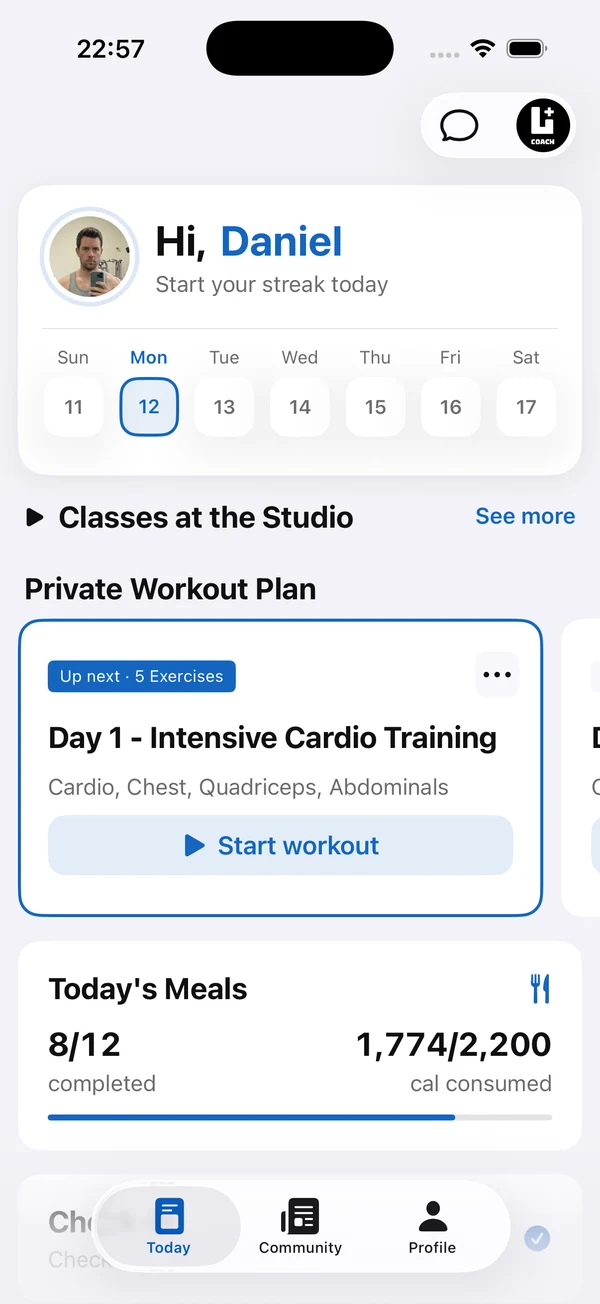
Run the break-even calculator for personal trainers again whenever a cost or your price changes. Fewer tools also means lower fixed costs. The Coach+ coaching platform puts training programs, meal plans with macro targets, food and workout logging and weekly check-ins with progress photos in one place, inside your own branded client app, with an AI assistant that drafts programs and meal plans for you to review. There is a 30-day free trial, no credit card needed.
Frequently asked questions
What is a break-even point for a personal trainer?
It is the number of paying clients at which your revenue covers all your costs, so you make neither a profit nor a loss. Every client after that adds their contribution margin to your profit.
How many clients does a personal trainer need to break even?
Monthly fixed costs ÷ (price − variable cost per client), rounded up. With $800 in fixed costs, a $200 price and $20 in variable costs, it is 5 clients.
What is contribution margin per client?
It is the monthly price minus the variable cost of serving that client. At $200 with $20 in payment fees and per-client costs, the contribution margin is $180.
Should I include my own salary in fixed costs?
Include it in one place only. Putting what you want to pay yourself in target profit keeps break-even as the true survival point and shows separately how many clients your income needs.
What if my price is lower than my variable cost per client?
Then you can never break even, because each new client adds to your loss. Raise the price or reduce per-client costs before looking for more clients.