Personal Training Software for Studios and Gyms: Managing Multiple Trainers Without Shared Passwords
6 min read · Updated Oct 12, 2026
Short answer
Personal training software for a studio or gym is a shared system where every trainer has their own login and role, and works from the same program library, client profiles and weekly schedule. It replaces shared passwords and group chats, so client management stays with the studio and a client can change coaches without starting over.
Many studios run without any personal training software at all: three or four coaches share one login, a group chat and whatever each coach keeps in their own notes. It holds together until a coach gets sick, goes on holiday or leaves, and a client shows up to a session nobody prepared for.
This guide covers the setup that keeps a coaching team organized: who can do what, where client information lives, and how to hand a client from one coach to another without losing anything.
Why do shared logins and group chats fail in a studio or gym?
They fail because nobody is accountable for changes, access never fully ends, and what each coach knows about a client stays with that coach.
- You can’t tell who changed what. When five people use one account, a deleted program or an edited price has no name on it.
- Access never really ends. When a coach leaves, the password leaves with them. Changing it means updating everyone else.
- Client knowledge lives in people’s phones. Injuries, preferences and last week’s conversation sit with one coach. The next coach starts from zero.
- Everyone can touch everything. A new coach gets the same access to billing and branding as the owner, whether they need it or not.
Should every trainer have their own login?
Yes. The first rule of a multi-coach studio is simple: one person, one account. Personal logins show you who is active and who did what, and they let you close access for one person without touching anyone else. Use an account each coach already has, like Google, so nobody needs to remember another password.
What roles does a coaching team need?
Most studios only need two roles, split by responsibility rather than seniority.
- Coaches work with clients: programs, check-ins, messages and sessions. That’s the job, and it’s all they need to see.
- Admins run the business: branding, billing and who is on the team. Keep this to the owner and one trusted person, so there’s always a backup.
A senior coach doesn’t need admin access to coach well. Handing it out "just in case" is how a studio’s colors or app name change by accident.
Is personal training software the same as gym management software?
No. Gym management software usually runs the front of the business: memberships, door access, billing and point of sale. Personal training software, often called fitness studio software when a whole team uses it, runs the coaching itself: programs, logged workouts, check-ins, client notes and the schedule. A coaching team needs the second to keep client history in the business, and many gyms run both.
What should personal trainer software do for client management?
It should keep everything about a client on one profile the whole team can open: the current program, logged workouts, check-ins, injuries and private notes, plus the conversation with the client. When that profile is the single source, any coach can pick up a session, and the owner can see who is training without asking around.
How do you hand a client from one trainer to another?
Move the program, notes and history with the client, introduce the new coach yourself, and check the client’s training after one week. In five steps:
- 1
Keep one shared program library
Build programs in one library the whole team can see and edit. When a client changes coaches, the new coach continues the same program instead of writing a new one.
- 2
Keep client notes on the client, not in a chat
Injuries, limitations, goals and preferences go on the client’s profile. Anything the next coach should know belongs there.
- 3
Write a short handoff note
Current program and week, last check-in, what’s working, what to watch. Five lines is enough.
- 4
Introduce the new coach in the client’s chat
One message from the current coach ("Dana is taking over your sessions from Sunday, she has your full history") keeps the client from feeling passed around.
- 5
Check in after the first week
The previous coach or the lead coach looks at the client’s logged workouts after week one. Fewer workouts is the first sign the handoff didn’t land.
Should a studio run one shared schedule?
Yes. When each coach keeps a separate calendar, classes overlap and members get mixed messages. Put every class on one weekly schedule the whole team can see, with the coach’s name on each session. Members see one studio, not five separate businesses.
How do you manage multiple trainers week to week?
With a 20-minute team review once a week. Look at the team’s clients together: who went quiet, who hasn’t trained in seven days or more, and which coach is close to full. Give each quiet client one named coach who sends the follow-up. Without a name next to it, nobody sends it.
How Coach+ handles a coaching team
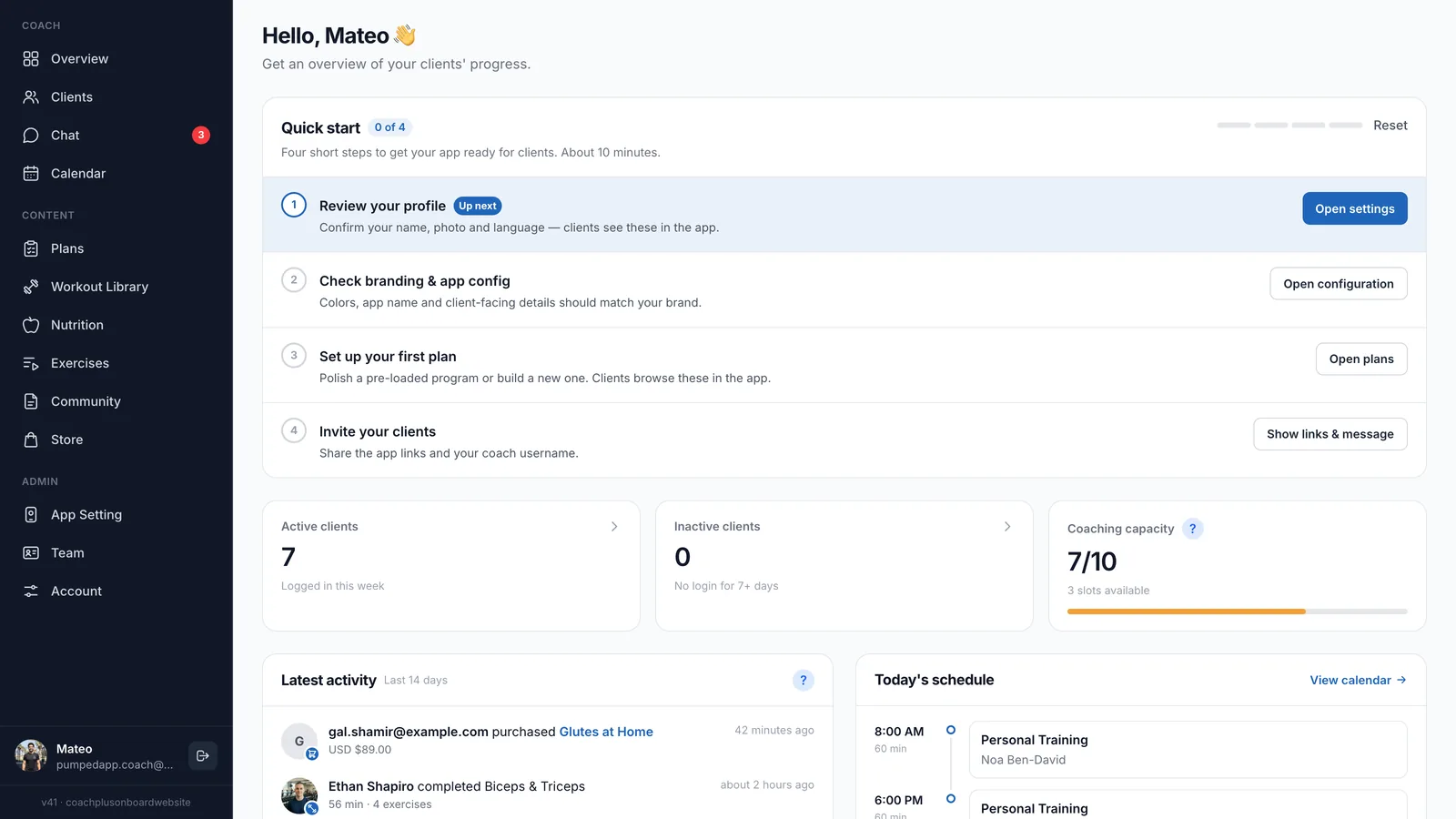
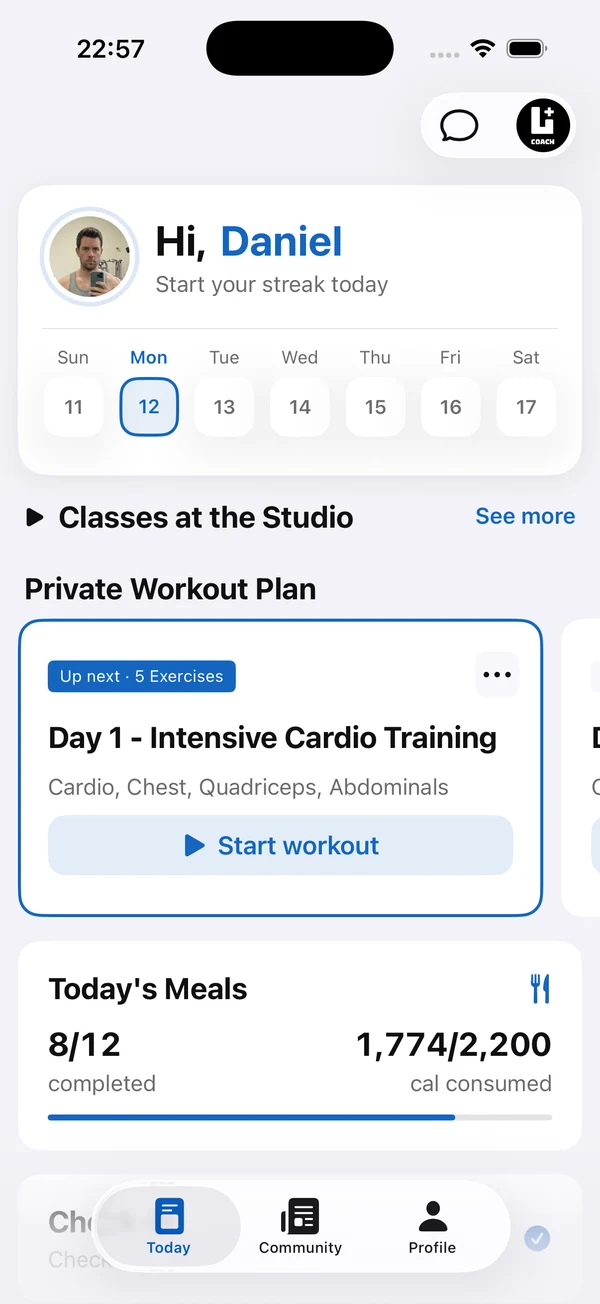
The Coach+ coaching platform gives your team one coach dashboard, and every client gets your studio’s own branded app, connected to it. Coaches and clients each have their own app, and everything stays in one platform.
- Each coach signs in to the dashboard with their own Google account. The Team page shows every coach, their role and when they were last active.
- Two roles, Coach and Admin. Admins change roles, and App Setting and Plan & Billing are admin-only.
- One Workout Library for the whole team and, with studio scheduling, a weekly Schedule where every session shows the coach who added it.
- A profile for each client with their program, completed workouts, check-ins, training volume and notes the client doesn’t see, plus a chat with each client.
Personal training software checklist for studios and gyms
- Every coach has a personal login
- Admin access for the owner and one backup only
- One shared program library
- Client notes live on the client’s profile
- A handoff note and an intro message for every handoff
- One weekly schedule for the studio
- 20 minutes a week to review quiet clients
Frequently asked questions
What features should fitness studio software have?
At minimum: a personal login for each trainer, separate coach and admin roles, a shared program library, a profile for each client with notes and history, and one schedule for the studio. A branded app for clients helps them see one studio instead of several separate trainers.
What is personal trainer software for client management?
Software that keeps each client’s program, logged workouts, check-ins, notes and messages together instead of spread across chats and spreadsheets. In a studio, every trainer with access works from the same record, so client history belongs to the business.
What happens to client data when a trainer leaves the studio?
If programs, notes and history live in the studio’s shared software instead of the trainer’s phone, nothing leaves with them. You close that trainer’s login and assign their clients to another coach.
Is Coach+ gym management software?
Coach+ covers the coaching side of a studio or gym: programs, logged workouts, check-ins, a coaching team with roles, a studio schedule depending on the plan, and a branded app for clients. It doesn’t handle door access, membership billing or point of sale, so gyms that need those keep a separate system.
Does Coach+ support multiple coaches?
Yes. Each coach signs in to the Coach+ dashboard with their own Google account and a Coach or Admin role, the team shares one Workout Library, and clients use the studio’s branded app.