Small group personal training is how many trainers grow past the hours in their day. One-on-one sessions cap your income at the number of slots you can fill. A group of four in the same hour earns more per hour, while each client pays less than a private session.
The risk is that the group turns into a class and clients stop feeling coached. This guide covers group size, pricing, programming for mixed levels, and the systems that keep every person in the group on their own track.
What is small group personal training?
It is personal training for a small, fixed group, usually two to six people, who train together at set times. Unlike a class, the coach knows each person’s goal, history and numbers, and adjusts the session for them.
- Semi-private (2–3 clients): close to one-on-one attention, often friends or couples who train together.
- Small group (4–6 clients): enough people for energy and a lower price, still few enough to watch every rep.
- Larger than that: it starts to work like a class, and individual progress is harder to track.
How many people should be in a small group?
Most trainers do best with four to six. The real limit is how many people you can watch and correct during the hardest set of the session.
- Equipment: count racks, benches and dumbbell pairs. If two people wait for one rack, the group is too big for that space.
- Experience: a group of beginners learning to squat needs more eyes than a group of experienced lifters.
- Fixed membership: the same people in the same slot each week build a group that holds each other accountable.
How much should you charge for small group personal training?
Price it so each client pays clearly less than a private session while you earn more per hour than you do one-on-one. Start from your own one-on-one rate and work out both numbers.
- 1Write down your hourly one-on-one rateThis is the number the group needs to beat for you.
- 2Pick a per-person priceChoose a price that feels like a real saving to the client compared with a private session.
- 3Multiply by a realistic group sizeUse the number who usually show up, not the maximum. If that total is not above your private rate, raise the price or the group size.
- 4Sell it monthlyA monthly package with a fixed slot is easier to plan than single drop-ins, and clients who have paid for the month tend to show up.
How do you program for different levels in one group?
Use one session structure for the whole group and individual numbers for each person. Everyone does the same block at the same time, with their own exercise variation, weight and reps.
- 1Same pattern, different variationone person goblet squats, another back squats, a third does box squats. All are squatting.
- 2Individual loadseach client logs their own weights so next week’s numbers are set for them, not for the group.
- 3Clear stationsfor circuits, pair people by level so the pace works for both.
- 4One focus per sessionsuch as a lower body day or an upper body day, so you can coach the main lift well.
How do you keep every client progressing?
Treat each group member as a full client outside the session: their own plan, their own log, their own check-in. The group gives energy. The individual follow-up is what keeps them paying.
How Coach+ helps you run small groups
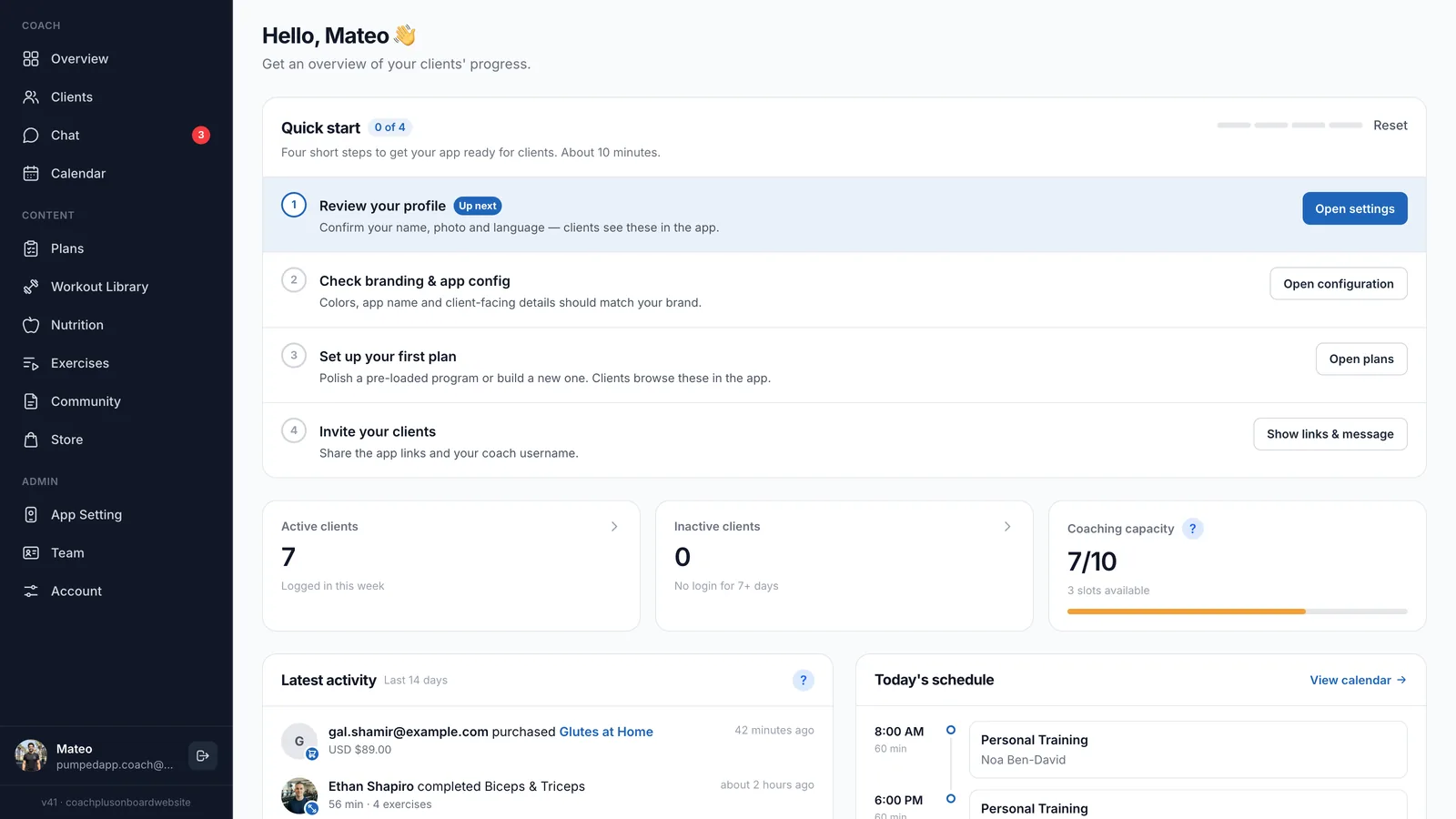
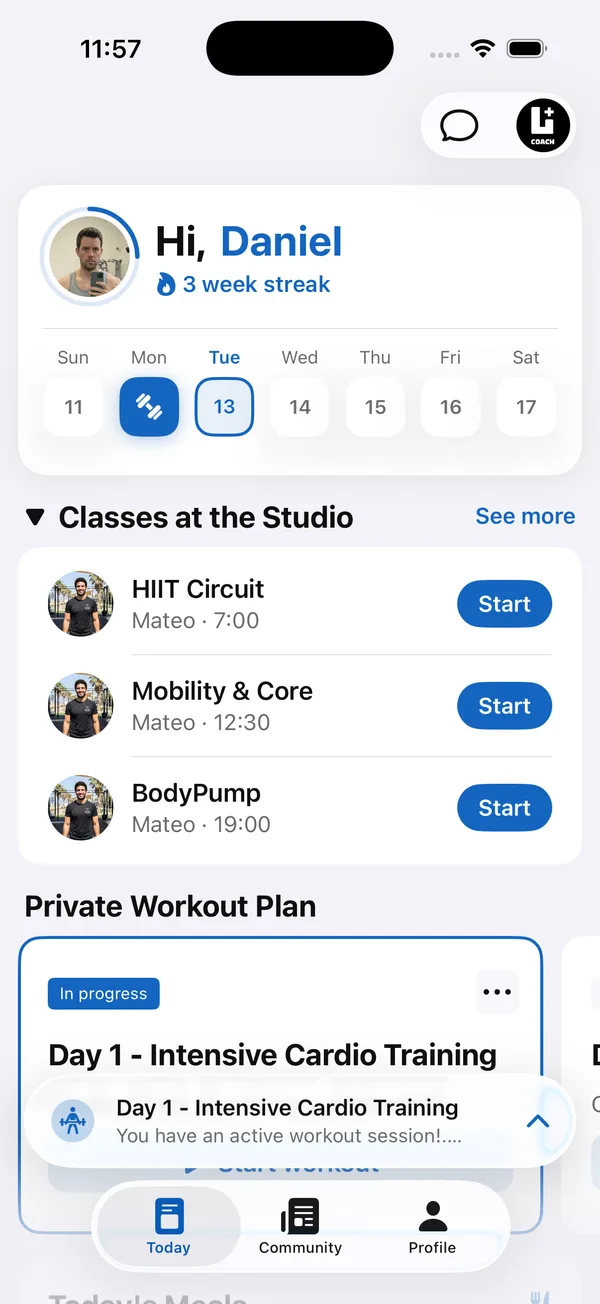
In Coach+ each group member is a client in your coach dashboard and has your branded app, so the group trains together while each person keeps their own plan and history.
- A workout and plan builder with 500+ exercises with demo videos and your own custom exercises, so you can build one session and adjust it per client.
- A calendar where clients book their own sessions, with Google Calendar sync.
- A private community feed in your app, where finished workouts and PRs post automatically, so the group sees each other train between sessions.
- Weekly check-ins with progress photos and messaging for each client.
- A nutrition builder with meal plans, templates and AI food search over 50,000+ food items, for clients who want nutrition coaching too.
- Teams of up to 10 coaches, if you run groups with other trainers.